
Hovering over an image will enlarge it and point out features (works better on desktop than on mobile).
 A camera indicates there are pictures.
 A speaker indicates that a botanical name is pronounced.
 A plus sign after a Latin name indicates that the species is further divided into varieties or subspecies.
Most habitat and range descriptions were obtained from Weakley's Flora.
Your search found 6 taxa in the family Hippocastanaceae, Buckeye family, as understood by Vascular Flora of the Carolinas.
)
)
)
)
)

 Common Name:
Painted Buckeye
Common Name:
Painted Buckeye
Weakley's Flora: (4/24/22) Aesculus sylvatica FAMILY: Sapindaceae
SYNONYMOUS WITH PLANTS National Database: Aesculus sylvatica FAMILY: Hippocastanaceae
SYNONYMOUS WITH Vascular Flora of the Carolinas (Radford, Ahles, & Bell, 1968): Aesculus sylvatica 116-01-001 FAMILY: Hippocastanaceae
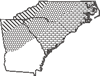
Habitat: In the Piedmont in mesic, nutrient-rich forests, on bottomlands, lower slopes, and in ravines, in the Coastal Plain primarily on floodplains of brownwater (alluvium-carrying) rivers (most notably the Roanoke River in NC), in the Mountains only at low elevations
Common in Piedmont (uncommon ro rare elsewhere in GA-NC-SC)
Native to the Carolinas & Georgia
)
)
)
)
)

Common Name:
Red Buckeye
Weakley's Flora: (4/24/22) Aesculus pavia var. pavia FAMILY: Sapindaceae
SYNONYMOUS WITH PLANTS National Database: Aesculus pavia var. pavia FAMILY: Hippocastanaceae
INCLUDED WITHIN Vascular Flora of the Carolinas (Radford, Ahles, & Bell, 1968): Aesculus pavia 116-01-002 FAMILY: Hippocastanaceae
Habitat: Coastal Plain marl forests (wet, calcareous flats), hardwood bluffs, rich floodplains of brownwater and blackwater rivers, basic-mesic forests, shell hammocks and shell middens, calcium-rich sandy soils in maritime forests
Common in GA Mountains & in Coastal Plain of GA & SC (uncommon in NC Coastal Plain) (rare in Piedmont)
Native to the Carolinas & Georgia
)
)
)
)
)
Common Name:
Yellow Buckeye
Weakley's Flora: (4/24/22) Aesculus flava FAMILY: Sapindaceae
SYNONYMOUS WITH PLANTS National Database: Aesculus flava FAMILY: Hippocastanaceae
SYNONYMOUS WITH Vascular Flora of the Carolinas (Radford, Ahles, & Bell, 1968): Aesculus octandra 116-01-003 FAMILY: Hippocastanaceae
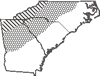
Habitat: Moist forests, up to nearly 2000 m, especially prominent in seepy cove forests, in the Piedmont only in ‘montane’ habitats
Common in Mountains, rare in Piedmont
Native to the Carolinas & Georgia
)
)
)
)

Common Name:
Ohio Buckeye, Fetid Buckeye, Chalky Buckeye
Weakley's Flora: (4/24/22) Aesculus glabra var. glabra FAMILY: Sapindaceae
SYNONYMOUS WITH PLANTS National Database: Aesculus glabra var. glabra FAMILY: Hippocastanaceae
Habitat: Mesic upland and riparian forests, bluffs, ravines, stream banks; usually over calcareous substrates
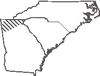
Rare
Native to Georgia
)
)
)
)
Common Name:
Bottlebrush Buckeye
Weakley's Flora: (4/24/22) Aesculus parviflora FAMILY: Sapindaceae
SYNONYMOUS WITH PLANTS National Database: Aesculus parviflora FAMILY: Hippocastanaceae
Habitat: Mesic forests on bluffs and in ravines (the SC occurrence is on Fall Line river bluffs, with shaley, subcalcareous soils)
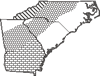
Rare in GA & SC (waifs in NC)
Native to South Carolina & Georgia
)
)
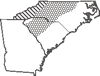
Common Name:
Horsechestnut
Weakley's Flora: (4/24/22) Aesculus hippocastanum FAMILY: Sapindaceae
SYNONYMOUS WITH PLANTS National Database: Aesculus hippocastanum FAMILY: Hippocastanaceae
Habitat: Urban and suburban areas, perhaps not definitely naturalized, but fairly often planted as a street tree and escaping as seedlings in the vicinity of plantings
Waif(s)
Non-native: southeast Europe
Your search found 6 taxa. You are on page PAGE 1 out of 1 pages.